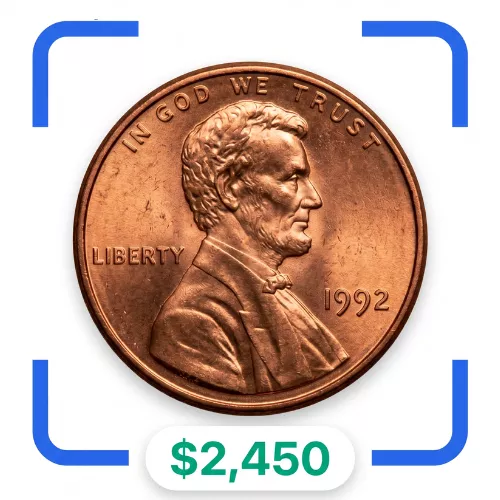
Lincoln Wheat Cent · Three Mint Marks · 95% Copper · Pre-War Issue

1941 Wheat Penny Value, Error list & Coin Identifier App

The last full-production copper wheat penny before wartime metal restrictions — and home to a Class I doubled die worth up to $35,000.

1.18B+

Total Minted

3 Mints

Philadelphia, Denver, San Francisco

$35,000

DDO Top Value (MS-67)

6

Error Types

Contents

The 1941 wheat penny occupies a remarkable position in American coinage history: it is the final year of full-production 95% copper Lincoln cents before wartime metal demands forced the U.S. Mint to experiment with alternative compositions. Struck at three facilities — Philadelphia, Denver, and San Francisco — the 1941 series delivered over 1.18 billion coins to circulation, yet still produced a roster of significant errors that command serious collector premiums. The JM Bullion 1941 Lincoln penny guide provides in-depth variety analysis, melt values, and certified population data for all three mint issues.

1941 Wheat Penny at a Glance

  • Composition: 95% copper, 5% tin & zinc
  • Weight: 3.11g — plain edge
  • Diameter: 19.05mm — Thickness: 1.52mm
  • Designer: Victor D. Brenner (obv. & rev.)
  • Total mintage: ~1.18 billion across three mints
  • Color grades: RD (Red) > RB (Red-Brown) > BN (Brown)
  • Mint marks: None = Philadelphia; D = Denver; S = San Francisco
  • Historic note: Last pre-wartime full copper issue; 1943 would be steel

For most collectors, the 1941 penny is an accessible, affordable wheat cent. Circulated examples trade near face value, and even gem-quality MS-67 RD examples are obtainable for modest sums. But the coin’s distinction as the final pre-war copper cent, combined with a potent doubled die obverse variety and a full suite of mint errors, makes it genuinely rewarding to study. To research current market prices across all grades, the 1941 Wheat Penny Value guide tracks real-time auction results and dealer prices for every variety.


Quick Value Check

Three questions to answer before diving deeper

🔴

Check the Obverse — Doubling?

Does LIBERTY show a strong shadow on the BER letters, or does IN GOD WE TRUST show separation? You may have the Class I DDO — potentially worth $288–$35,000 by grade.

🟡

Check the Mint Mark Under 10x

D or S mint mark coins: look for a secondary shadow impression offset north or south (RPM). True RPMs show raised, crisp secondary impressions — not flat machine doubling.

🟢

Grade the Color & Surface

Full red luster with no spots? MS-65 RD and above is where value accelerates sharply. Check for lamination bubbles or off-center striking — either adds significant premiums.

What You See Likely Scenario Estimated Value Next Step
Strong doubling on BER in LIBERTY / date DDO FS-101 ⭐ $288–$35,000 Authenticate & variety-attribute (PCGS/NGC)
Secondary D or S shadow on mint mark RPM variety $5–$75 Compare to CONECA/FS reference images
Raised bubbles or peeling on surface Lamination error $3–$50 Document extent of peeling, consider grading
Design off to one side, crescent blank Off-center strike $15–$600 Date must be visible; measure % off-center
Full red luster, MS-65 RD or better Premium mint state $15–$500+ Submit for PCGS/NGC grading
Normal copper, worn, any mint Common circulated $0.02–$0.25 Keep for type / date sets

Varieties & Mintage

Three mints — Philadelphia led with the largest cent production in U.S. history at the time

Variety Mintmark Mintage Rarity Key Notes
1941-P None (Philadelphia) 887,039,100 Abundant Home of the major DDO FS-101 variety; record Philadelphia mintage
1941-D D (Denver) 128,700,000 Common D/D RPM varieties exist; scarcer than P in high gem grades
1941-S S (San Francisco) 92,360,000 Scarcer Lowest mintage of the trio; S/S RPM varieties collectible; tougher in gem RD
1941 Proof None (Philadelphia) 21,100 Scarce Mirror-like fields; PR-65 RD most common grade seen; PR-67+ rare

🏭 Why 1941 Matters in Lincoln Cent History

1941 was the last year all three mints produced Lincoln cents in standard 95% copper composition at scale before the United States entered World War II. By 1943, copper was so critical to the war effort that the Mint switched entirely to zinc-coated steel. This makes the 1941 wheat penny the final representative of the original Lincoln cent format with pre-war metal purity, giving it significance beyond its moderate numismatic values and explaining why high-grade examples remain popular with type collectors and variety specialists alike.


Value by Grade

Standard copper business strikes — error coins priced separately in error section

Circulated Grades (G-4 to AU-58)

Grade 1941-P 1941-D 1941-S
G-4 (Good)$0.05$0.08$0.10
VG-8 (Very Good)$0.10$0.15$0.20
F-12 (Fine)$0.15$0.20$0.35
VF-20 (Very Fine)$0.25$0.35$0.50
EF-40 (Extremely Fine)$0.50$0.75$1.00
AU-58 (About Uncirculated)$2.00$3.00$4.00

Mint State Grades (MS-60 to MS-67) — by Color

Grade P — BN P — RD D — RD S — RD
MS-60$1$3$4$5
MS-63$3$8$10$12
MS-65$12$25$30$45
MS-66$35$75$90$150
MS-67 RD$250+$400+$650+
Proof PR-65 RD$100–$350

1941 Wheat Penny Error List with Pictures

Six documented error types — from $3 laminations to a $35,000 doubled die

1941 Wheat Penny — Error Coin Reference

# Error Type Rarity Circulated MS / Uncirculated
1Doubled Die Obverse (DDO FS-101) ⭐Scarce$50–$500$288–$35,000
2Repunched Mint Mark (RPM)Uncommon$5–$25$35–$75
3Lamination ErrorOccasional$3–$20$15–$50+
4Off-Center StrikeOccasional$15–$75$75–$600+
5BIE Die Crack ErrorCommon$5–$15$12–$35
6Die Crack / Die BreakCommon (minor)$2–$15$8–$75

Error #1: Doubled Die Obverse (DDO FS-101) ⭐

The crown jewel of 1941 errors — Class I counterclockwise hub rotation with dramatic BER doubling

1941 wheat penny doubled die obverse DDO error

1941-P DDO FS-101 — strong doubling visible on BER in LIBERTY and IN GOD WE TRUST

This represents the crown jewel of 1941 wheat penny errors. Created by a Class I counterclockwise hub rotation during Philadelphia Mint production, the doubled die obverse displays unmistakable doubling patterns most prominently on the BER portion of LIBERTY. The error extends to IN GOD WE TRUST and creates noticeable separation on the number 4 in the date.

Value Range:

MS-62 BN examples start around $288 • MS-66 RD specimens have achieved $9,200 • MS-67 potentially reaching $35,000 based on auction records

How to identify: The doubled die creates a characteristic shadow effect visible without magnification on higher grade examples. Under 10x, examine vertical strokes of letters in LIBERTY, especially B, E, and R where doubling appears as complete secondary impressions rather than flat shelf doubling. The date’s final 1 also shows pronounced separation. Three distinct types exist for 1941, but Type 1 (FS-101) remains most valuable.

Value: $288 (MS-62 BN) — $35,000 (MS-67 RD, estimated)

Error #2: Repunched Mint Mark (RPM)

D/D and S/S varieties — secondary mint mark impression visible under magnification

1941 wheat penny repunched mint mark RPM error

1941-S/S RPM — secondary S impression offset north, visible under 5x magnification

Before automated processes, mint marks were manually punched into each working die using steel puncheons and hammers. When the initial punch was too weak or misaligned, technicians repunched the mint mark, creating visible doubled or tripled impressions. The 1941-S/S varieties are particularly collectible, showing the S mint mark with a secondary shadow impression offset north or in other directions.

Value Range:

Most 1941 repunched mint marks: $5–$25 in circulated grades • Well-preserved uncirculated examples with strong doubling: $35–$75

How to identify: Position the coin under bright light at various angles while using at least 5x magnification. Look directly below the date where the mint mark appears. True RPMs show crisp, raised secondary impressions with distinct separation and depth, appearing as D/D or S/S. Avoid confusing RPMs with machine doubling, which appears flat and rounded rather than showing the sharp, incused characteristics of genuine repunching.

Value: $5–$25 (circulated) — $35–$75 (uncirculated)

Error #3: Lamination Error

Wartime production pressures caused impurities that split copper planchets in layers
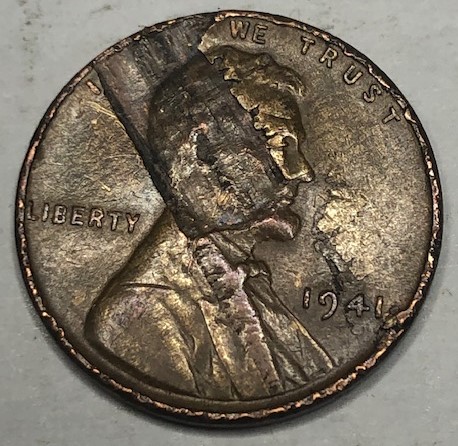
1941 wheat penny lamination error

1941 lamination error — copper planchet peeling away in layers on the obverse

Wartime production pressures and metal quality issues during the early 1940s led to an increased occurrence of lamination errors. These develop when impurities, gas bubbles, or improper alloy mixing cause the copper planchet’s layers to separate. The metal literally peels apart in sheets, creating distinctive flaking or missing sections that expose underlying layers.

Value Range:

Minor surface laminations: $3–$8 • Moderate laminations (10–25% of surface): $10–$20 • Major laminations with significant peeling or missing sections: $15–$50+

How to identify: Lamination errors appear as raised, bubbled areas ready to flake off, or sections where metal has already separated revealing a different colored underlayer. Most commonly found on the obverse around Lincoln’s portrait or on the reverse wheat stalks. Distinguish from post-mint damage by examining whether the separation follows the metal’s grain structure rather than showing signs of external impact.

Value: $3–$8 (minor) — $50+ (major, dramatic peeling)

Error #4: Off-Center Strike

Misaligned planchet during striking — value rises sharply with percentage and date visibility
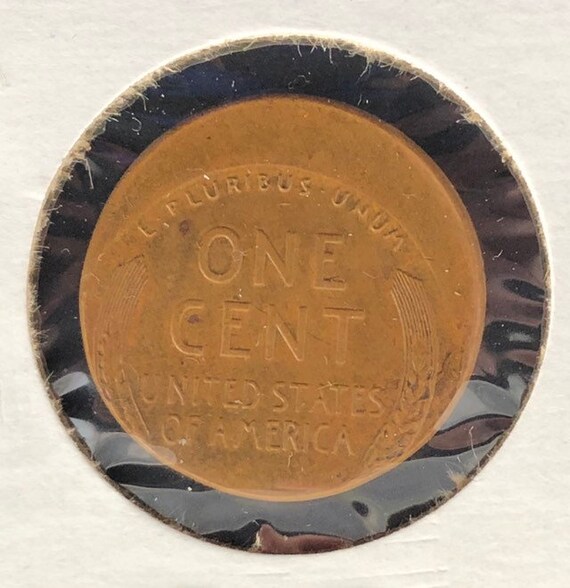
1941 wheat penny off-center strike error

1941 off-center strike — approximately 25% misalignment with full date visible

Mechanical failures in the feeding mechanism occasionally allow planchets to enter the striking chamber misaligned with the dies. When struck in this position, the design impresses on only part of the blank, leaving a crescent-shaped unstruck area. The corresponding opposite edge shows blank planchet extending beyond the normal rim.

Value Range:

5–10% off-center: $15–$30 • 15–25% off-center: $35–$75 • 40–50% off-center with visible date: $100–$250 • Dramatic 75%+ off-center with full date: $300–$600+

How to identify: The date must remain fully visible for maximum value. Measure the percentage by estimating how much of the design remains on the planchet versus blank area. The struck portion should show normal relief and detail. Off-center strikes toward 3 o’clock or 9 o’clock positions typically bring highest values as they maximize blank area while keeping the date visible.

Value: $15–$30 (5–10%) — $600+ (75%+, full date visible)

Error #5: BIE Die Crack Error

Die deterioration crack between B and E in LIBERTY creates a false “I” letter
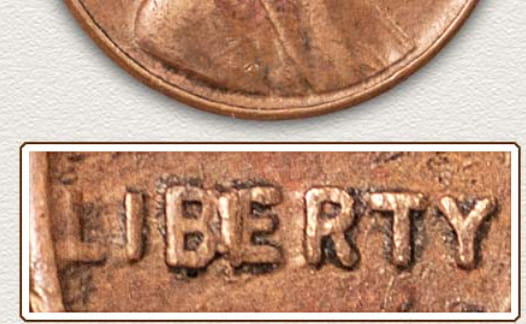
1941 wheat penny BIE die crack error

1941 BIE error — raised vertical crack between B and E in LIBERTY transforms it to L-I-B-I-E-R-T-Y

The BIE error results from die deterioration rather than a striking mistake. As dies experience repeated stress from striking thousands of coins, metal fatigue causes thin cracks to develop. When a crack forms precisely between the B and E in LIBERTY, it fills with metal during striking, creating a raised line resembling the letter I. This transforms LIBERTY into L-I-B-I-E-R-T-Y in appearance.

Value Range:

Minor BIE cracks barely visible: $5–$10 • Moderate BIE clearly visible to naked eye: $12–$20 • Strong, prominent BIE errors in higher grades: $20–$35

How to identify: Focus examination on the space between B and E in LIBERTY using at least 3x magnification. The BIE appears as a thin, raised vertical line connecting the bottom of these letters. The line should be uniform in thickness and show the same relief as surrounding letters. Check if the crack extends beyond the BE space — some cracks continue through additional letters, commanding higher premiums.

Value: $5–$10 (minor) — $20–$35 (strong, prominent)

Error #6: Die Crack / Die Break

Stress fractures in the working die create raised lines and cuds on struck coins
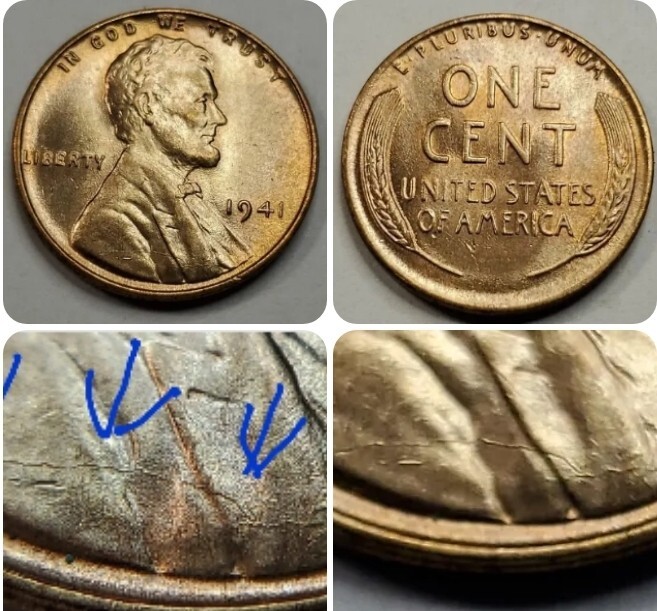
1941 wheat penny die crack die break error

1941 die crack — raised irregular line traversing Lincoln’s portrait from rim to date

As working dies strike hundreds of thousands of coins, immense pressure causes metal fatigue resulting in fractures across the die face. These cracks fill with displaced metal from subsequent planchets, creating raised lines on finished coins. Die cracks can traverse any portion of the design, from minor hairlines to major fractures spanning rim to rim. Major breaks at the rim — called cuds — are the most valuable, forming a raised blank area where the die’s edge broke away.

Value Range:

Minor single die cracks: $2–$5 • Moderate cracks crossing major design elements: $8–$15 • Major cracks or multiple intersecting cracks: $15–$35 • Extensive die breaks approaching cud: $30–$75

How to identify: Die cracks appear as raised irregular lines on the coin’s surface. They follow random, jagged paths determined by stress fractures in the die — not straight mechanical lines. Run your finger gently across suspected cracks: genuine die cracks feel slightly raised. Multiple intersecting cracks or cracks approaching the rim suggest advanced die deterioration and command higher collector interest.

Value: $2–$5 (minor crack) — $75 (major cud at rim)


Recent Auction Results

Verified public auction records — establishes real market benchmarks

Coin Grade Sale Price Auction House Date
1941-P DDO FS-101PCGS MS-66 RD$9,200Heritage Auctions2022
1941-P DDO FS-101PCGS MS-65 RD$4,800Stack’s Bowers2021
1941-P MS-67 RDPCGS MS-67 RD$1,560Heritage Auctions2023
1941-S MS-67 RDPCGS MS-67 RD$720GreatCollections2023
1941-P Off-Center 50%PCGS MS-63 RB$216Heritage Auctions2022
1941 Proof PR-65 RDPCGS PR-65 RD$192GreatCollections2023
“The 1941 wheat penny sits at a historical crossroads — the last great pre-war copper cent, carrying errors that span from common die cracks to a doubled die variety rivaling the rarest coins in the Lincoln series.”

Identify Your 1941 Wheat Penny with CoinKnow

Detect DDO doubling, RPM varieties, lamination, and off-center strikes in seconds

📷

Snap Both Sides

CoinKnow instantly reads the wheat reverse design and identifies the mint mark, flagging DDO and RPM candidates immediately from your photo.

🔍

Detect Varieties

Automatic detection for hub doubling vs machine doubling, secondary mint mark impressions, lamination areas, and off-center strike percentages.

💰

Get Instant Value

RD/RB/BN color grading, Sheldon Scale grade estimate, and real-time auction comparisons from Heritage, Stack’s Bowers, and GreatCollections.

Pro Workflow: 1941 Wheat Penny Evaluation Steps

1.Photograph the obverse first — look for doubling on BER in LIBERTY before anything else
2.Check D or S mint mark under 10x for secondary impressions (RPM varieties)
3.Inspect the surface for raised bubbles or peeling layers (lamination errors)
4.Weigh the coin: 3.11g = normal copper planchet; unusual weight suggests wrong planchet
5.Use CoinKnow to match against CONECA variety database before submitting to grading services
6.Submit any coin potentially worth $100+ to PCGS or NGC for certification

Reality Check & Action Plan

What most 1941 wheat pennies are actually worth — and when to act

Scenario Realistic Value Action
Strong DDO with BER doubling, MS-65+ RD$4,800–$35,000+Grade & variety-attribute at PCGS/NGC immediately
DDO visible, circulated to MS-64$288–$1,500Authenticate & attribute (PCGS/NGC)
75%+ off-center strike, full date visible$300–$600+Measure percentage precisely, then authenticate
RPM secondary impression visible under 10x$35–$75Attribute to specific CONECA/FS variety, grade
Major lamination covering 25%+ of surface$20–$50+Document with quality photos before handling
MS-65–67 RD, any mint, no error$25–$650Consider grading if full red and well-struck
Circulated copper, any condition$0.05–$0.50Keep for type / date / wheat cent sets
  1. 1.Check LIBERTY first on every 1941-P. The DDO FS-101 is the highest-value variety available for this date — a quick look under 5x can reveal thousands of dollars in premium.
  2. 2.Never clean your coin. Original surface preservation is everything — cleaning permanently destroys any RD color premium and reduces value dramatically.
  3. 3.Hub doubling vs machine doubling. Only genuine hub doubling carries numismatic value. Machine doubling creates flat, shelf-like images with no depth — learn to distinguish them before attributing a DDO.
  4. 4.Measure off-center percentages accurately. Value rises non-linearly with percentage — a coin at 50% off-center can be worth 5× a 20% example when the date remains fully visible.
  5. 5.The 1941-S is the key date for gem RD. At only 92 million struck, the San Francisco issue is meaningfully tougher in MS-67 RD condition and commands significant premiums over Philadelphia at that level.

The 1941 wheat penny occupies a unique crossroads in the Lincoln cent story. As the final pre-war copper cent at full production scale, it connects the classic wheat era of the 1910s and 1920s to the wartime disruptions that followed in 1942 and 1943. For most collectors, the 1941 is an affordable, satisfying wheat cent — common in circulation, rewarding in gem condition, and accessible through RPM and DDO variety collecting. But for the specialist who finds a sharply struck Philadelphia cent showing strong doubling on LIBERTY, the 1941 penny can deliver one of the most dramatic numismatic discoveries in the Lincoln cent series.

“The 1941 wheat penny is simultaneously the most historically accessible pre-war Lincoln cent and home to one of its greatest doubled die varieties — a coin that rewards careful examination at every grade level.”